18th Century Habsburg Vienna: A Pic Spam
Nov. 8th, 2025 09:06 am![[personal profile]](https://www.dreamwidth.org/img/silk/identity/user.png) selenak posting in
selenak posting in ![[community profile]](https://www.dreamwidth.org/img/silk/identity/community.png) rheinsberg
rheinsberg
Vienna was unseen by our antihero, but home to his arch nemesis, and to this day very much imprinted by her and her family. Have the pictorial result of three days following their footsteps:
The Hofburg, the official main Vienna residence of the Habsburg Emperors, is a big complex of buildings, most of which today are in classical style due to 19th century renovations. But of course they contain parts that were there in the 18th century and/or are dedicated to people from it. Here's the part that has the most famous statue of Eugene of Savoy in front of it:

The more famous front facade of this part of the Hofburg is this:

From that side, you also get to the famous Spanische Hofreiterschule, cult place for riders and horse lovers since centuries. It's forbidden to tace pics of the presentations, but in the inner part today looks like this:

Young MT to make a point did an exercise which until then had just been reserved for the gentlemen - riding and carriage driving competitions in a "Carousel" (this was very popular in all countries among the nobility; AW organized a famous one in Berlin) - with her ladies here:

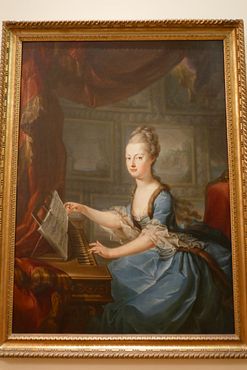
Mostly the Hofburg is used as a gigantic museum. Here are some of the instruments from back in the day, including the piano child prodigy Mozart (and sister Nannerl) played on when presented to the Imperial family in the early 1760s, and a painting of young Maria Antonia, aka Marie Antoinette, whom according to legend young Wolferl - they were the same age - proposed on that occasion:

And a Habsburg family tree made in the late 17th century (i.e. MT is not on it):

Part of the Hofburg complex is also today's Austrian National Library, founded by MT's Dad, Emperor Charles VI:


(The statue is inevitably him, of course.)
While we're talking the generation of MT's Dad, the big hero of the era was Eugene of Savoy, famous general , thorn in Louis XIV's side and "wise advisor to three Emperors" as the plaque beneath his statue calls him, whose main residence, the Belvedere, was later sold by his niece and heir to MT. The Belvedere is separated in the Lower and Upper Belvedere. Both look gorgeous, but courtesy of a fire the Upper Belvedere inside is mostly modern and used as an art museum, though each room shows a print of how it looked in Eugene's day and to which purpose he used it. Some, a very few, survive in their original setting or could be restored. The Upper Belvedere is also where the Second Austrian Republic was declared after WW2.
Upper Belvedere:

Lower Belvedere:

Some of the remaining rooms, including the big state room where they declared the Second Austrian Republic:


(The art displayed in the Belvedere includes the most famous paintings of Gustav Klimt like "The Lovers", but that's really beyond our era.)
Many a dead Habsburg ended up in the famous Capuchin Crypt, the Kapuzinergruft (or most of their bodies anyway; the Habsburgs famously had their hearts and inwards buried in different churches from the rest of the bodies). We're talking 400 years of dead Habsburgs, with the latest entries being Otto of Habsburg (Member of the European Parliament), I believe, and starting in 1618 with the Empress Anna.

Just as a point of comparison for what's to come, here are the sarcophagi of Emperors Leopold I. and Joseph I. (i.e. MT's uncles, two of Eugene's three Emperors):


MT's mother, the original Elisabeth Christine of Brunswick, whom her niece (wife of Fritz) was named after:

We're building towards something here. And then you enter the Maria Theresia Vault:

That's Joseph II in the pointedly modest copper coffin in front of the baroque splendour of his parents' tomb. Sums up Joseph's mixed emotions about his parents (and/or his mother) perfectly. He did make a point, but he also wanted to be there, as opposed to in his own vault (which is what brother Leopold did), or in this vault and next to his dead first wife instead of at his mother's feet, but no. Also: you'll notice flowers. MT and FS got a lot, Joseph got a white and a red rose. I don't excpect this to be the case every day, but on November 4th, it's only three days after All Soul's Day during which he visit the dead.


Believe me when I say no other Habsburg couple in the Kapuzinergruft had themselves depicted like this, looking at each other and sharing one tomb. Rather fitting for the couple who unfasihionably shared a bed for purposes other than reproduction in their life. Also in the Maria Theresia vault: those of their sixteen children who didn't live beyond toddlerdom or babydom, both of Joseph's wives, and his only daughter who also died as a child.
Poor unloved Maria Josepha of Bavaria, Joseph's second wife:

The very much loved Isabella of Parma, Joseph's first wife, who loved his sister Maria Christina:

With their daughter, little Maria Theresia:

Little MT's tomb:


The most famous church in Vienna, the Stefansdom (St. Stephen's Cathedral) was where Joseph and Isabella got married, and usually when they show you a picture of the Stephansdom in the 18th century from inside, it's the depiction of that wedding. This it how the church looks today:


As you may imagine, the towers of the Stefansdom offer a spectacular view over Vienna in all directions. Here are just two selections (and note the famous Ferris Wheel from the Prater in one):


Before going to the Vienna outskirts (today - back then it was really separate from the city) for Schönbrunn, a trip to the Maria Theresia Square, where she's depicted with her most important generals (like Traun) and advisors (like Kaunitz), but also Dr. Van Swieten, he who promoted anti smallpox inocculation.


On that square, you get the natural history museum and the art history museum of Vienna. The art history museum includes a lot of gorgeous Dürers and Cranachs, as well as Egyptian, Greek and Roman art (again, not our era), but also these portrait busts of Joseph II as Archduke and of Marie Antoinette as Dauphine of France:

and a couple of Habsburg showcasing the infamous family features, starting with Charles II. of Spain, the cousin who was the last of the Spanish Habsburg line, and later including Uncle Leopold:

Now, onto Schönbrunn. Which like Versailles started out as hunting lodge. It was given to MT as a summer residence by her father and she then turned into her favourite residence and into a major palace.

From the outside, Schönbrunn is best seen from above, from the "Gloriette", which wasn't finished until the 1770s, which is why it is inscribed to both Joseph and MT. This is the Gloriette:

And again, view of Schönbrunn (and Vienna behind it):

If Versailles hosted several French kings and their spouses but leaves no question as to which King is the most influential one, Schönbrunn, home to all the Habsburg rulers after MT as well, including Franz Josef and wife Sisi of many a movie faame, also leave you in no doubt who's boss right at the start of the tour:


There is another family tree, this one going from Rudolf I. (first Habsburg to make it from Count to King of the Romans, if not Emperor) to the last Emperors

There are the big state rooms, like the mirror gallery (gotta have one as a Baroque and Rokoko prince(ss):


And the more intimate family rooms where MT & Co. actually lived, like the family dining room:


And this is the little audience chamber. This is the very room where six years old Wolfgang Amadé Mozart played for the Empress, and according to his father's letter immediately after the event hugged her and kissed her. Also where according to legend he fell down on the floor and was helped up by litlte Marie Antoinette whereupon he said he liked her and wanted to marry her.

Antechambre:

Two of MT's cabinets. One is called the Turkish Cabinet and includes a painting (well, the print of one, the original is in the Kunsthistorisches Museum) showing her wearing a Turkish costume, which I don't think I've seen in any biography:

and the other is the so-called "Chinese Cabinet". This is where MT worked with Kaunitz. It's also unlike the Turkish Cabinet behind glass, hence a lesser quality of photo:

Probably most expensive room in the place, due to the materials involved, which include Indian tapestries which were recut by members of the Imperial family and used to decorate the wall as Intarsien:


And lastly, a bedroom which is famous not for the FS portrait on the wall but because in it the Duke of Reichstadt, aka the son of Napoleon and Austrian Archduchess Marie Louise, nicknamed "L'Aiglon" died on the chaiselongue you see there:

(Marie Louise is buried in the Capuchin Crypt along with the other Habsburgs, btw.)
Schönbrunn's former stables host a variety of carriages.
This one, "the Imperial Coronation One", was used by Ferdinand II (infamous for being one of the main culprits for the Thirty-Years-War):

This was the kind of sedan chair used to have yourself carried around a noble person in 18th century Vienna:

Winter sledge for enterprising archdukes and arch duchesses:

The coronation carriage used by FS and young Joseph when Joseph was elected King of the Romans in Frankfurt (with young Goethe and most of Frankfurt attending). Back then it was still golden, but was painted black in later years. But it is the very carriage.

Llike the Georgians, the 18th Century Habsburgs were into gardening and hence there is a palm tree house:


And with one more look at Schönbrunn and Vienna, this one taken from the Treewalk path which is also there but a very modern thing, I shall end this picspam:


no subject
Date: 2025-11-08 10:56 pm (UTC)The contrast between Joseph's and MT/FS's tombs could not be more striking indeed, wow. The Schönbrunn dining room picture immediately felt like a room where someone would actually live, but I did not expect a Turkish salon of all things - or MT in Turkish attire! Hm.
The winter sledges are as OTT as they are cute, and they immediately made me think of Ferdinand and his love for (fast) sledge-riding. :D Always here for those big greenhouses, too - but it's also an interesting contrast to anything Sanssouci had in terms of greenhouses, which was much smaller and, save for the terraces, completely utilitarian, simply designed to provide fruit.
no subject
Date: 2025-11-09 10:00 am (UTC)MT in a Turkish costume: indeed. Especially given there was still war with Turkey within her life time (though I don't think when she was actually ruling - obviously she wasn't as a toddler and girl, and Joseph made his alliance with Catherine against the Turks after her death). Then again, Lady Mary in her Embassy Letters makes a spirited point about how much more comfortable Turkish clothing is to wear for woemn (no kidding, especially if you think about MT's state robes). At any rate, it means Turkish things getting into fashion predates Mozart's Die Entführung aus dem Serail by decades, because given MT gained weight with her sixteen pregnancies, I'd say this is her in her late 20s, early 30s at the latest.
The greenhouse looks almost identical to the one G3 had at Kew, which I visited this year, so it seems to have been a general style for them.
no subject
Date: 2025-11-09 11:49 pm (UTC)Remember that there was also an Austrian alliance with Turkey in the late 1760s/early 1770s. MT was reluctant but eventually won over, and then felt bad about the various proposals from Kaunitz and Joseph to screw the Turks over/partition the Ottoman Empire in order to keep war from breaking out (the war that was eventually forestsalled by the First Polish Partition). She then spent a certain amount of time trying to speak up for the Turks in the name of faithfulness to the alliance.
You can read more about that in my write-up on 1764-1772 foreign policy here.
no subject
Date: 2025-11-09 11:53 pm (UTC)I kept saying I'd go to Schönbrunn "tomorrow" on my 2012 visit, but we did Vienna at the very end of a multi-week trip and my feet were tired from all the walking, and I never did summon up the will. Next time!
no subject
Date: 2025-11-10 08:36 am (UTC)no subject
Date: 2025-11-10 05:40 pm (UTC)That's Joseph II in the pointedly modest copper coffin in front of the baroque splendour of his parents' tomb. Sums up Joseph's mixed emotions about his parents (and/or his mother) perfectly. He did make a point, but he also wanted to be there, as opposed to in his own vault (which is what brother Leopold did), or in this vault and next to his dead first wife instead of at his mother's feet, but no.
Gosh, yes. That picture brings that across so well. These guys <3 And I love MT and FS looking at each other <3 -- I love the idea that that is what they imagined their idea of heaven to be like. And the children! :/ (The cherubs on the frescos! <3 )
Poor unloved Maria Josepha of Bavaria, Joseph's second wife:
Aw, I guess at least she got a nice tomb?
Your pics of Schönbrunn and the Gloriette are, well, glorious <3 And as someone who loves Rococo, of course I loved the hall of mirrors :D And the room with the cut tapestries was quite intriguing!
(I then of course had to go reread the lovely AU I got of (among other things) Fritz visiting -- or, I suppose permanently staying -- in Vienna! :D )
no subject
Date: 2025-11-11 09:15 am (UTC)Well, the "City of Music" label is well earned (and instead of all the Habsburg stuff I could have visited the Mozart museum(s), the Schubert museum, the Straus museum(s), the Beethoven museum(s) etc.), and technically Vienna never wwas "the capital of the Holy Roman Empire", it just happened to be the capital of Austria, and ever since the Habsburg managed to deadlock the (never forget, elective) office of HRE to their family that usually (but not always) meant it was the main residence of the reigning Archduke of Austria, whoh also happened to be the Emperor of the HRE.
Again: even then there were exceptions. Just think of the mightiest Habsburg Emperor ever, i.e. Charles V. - who never set foot into Vienna, even when he visited his German speaking territories. (He made his younger brother Ferdinand Regent of Austria, and Ferdinand did reside in Vienna. Though you couldn't say the capital of the HRE at the time was Madrid, or Brussels, or wherever Charles was allowing himself to reside for longer than five minutes, either, because unlike France and England, the HRE just didn't have one. The Emperors had favored residences, but the whole bloody thing was so large that most Emperors had to be on the move, and that was before the Habsburgs managed to marry gigantic new territories TWICE. (And then Charles retired and famously split his territories between what his son, Philip II. got (Spain and assorted territory beholden to Spain, like the overseas colonies) and what his brother Ferdinand got (the HRE, after the princes elector duly came through, plus Austria and territories beholden to Austria). Given that the sort of, kinda, not really Parliament of the HRE in its early modern history phase met in Regensburg/Ratisbon, and that the election of an Emperor and his coronation had to happen in Frankfurt, either city could in theory make as much a claim to capitaldom as Vienna could. And so could Prague, because all of the Emperors of the House of Luxemburg AND one of the Habsburg Emperors chose to reside there for most of their reign. In conclusion, the HRE didn't do proper capitals.
One thing is sure: if that AU happened, Viennese palaces would have seen a lot more dogs!